Buying a finca in Mallorca: rustic land, legalisation, water and holiday rental licences
Rustic land, unlicensed buildings and the extraordinary legalisation, water, wastewater and holiday rental licences: what to check before buying a finca in Mallorca.
In this article
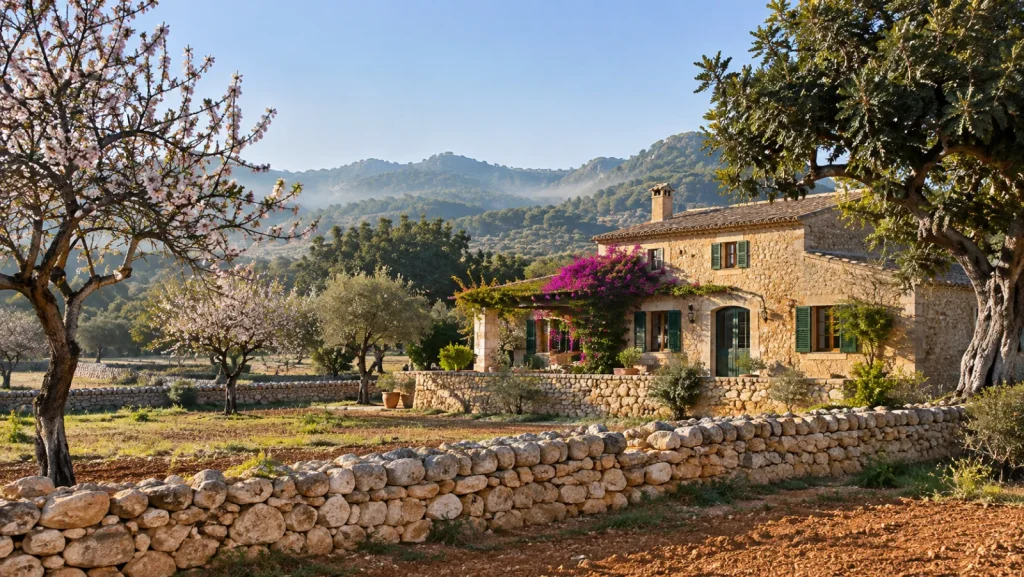
For many buyers, a finca in Mallorca is the dream home: a stone house in the countryside, among almond and olive trees, with space and quiet. But fincas sit on rustic land (suelo rústico), where the rules are much stricter than in a village or a residential estate. A finca can look perfect and still have half its buildings without a licence, depend on an unauthorised well, or be marketed with holiday lettings that are not actually allowed. Here is what to check before you buy, based on what we see every day in southeast Mallorca.
What rustic land is and why it matters
Almost all fincas are on rustic land, which is either common (común) or protected (protegido), such as natural areas of special interest, woodland or protected landscapes. The category of each plot is set by the Mallorca Territorial Plan and the town’s planning rules, and it decides what you can do there.
- To build a new house on common rustic land, the minimum plot is usually 14,000 m²; on protected land much more is required, or building is not allowed at all.
- Extensions are strictly limited in floor area and plot coverage, depending on the land category and the municipality.
- So do not buy thinking “we’ll extend later” or planning a second house without an architect first checking what that plot allows.
Licensed, time-barred or “fuera de ordenación”
It is very common for the main house to be legal while the pool, a covered terrace, a guest house or a garage were built without a licence. What matters is the status of each building:
- Licensed: everything is in order.
- Time-barred or “fuera de ordenación”: if the work was finished long ago (generally more than eight years on common rustic land), the authorities can no longer order demolition. The building can be used and maintained, but not extended. Rules are stricter on protected land.
- Unlicensed and not time-barred: the risky case. It can lead to fines and a demolition order, and the liability passes to the new owner.
The extraordinary legalisation (until February 2028)
Balearic Law 7/2024 opened an extraordinary procedure to legalise buildings on rustic land where the breach is already time-barred. In Mallorca it has applied since 15 February 2025, for three years. The key points:
- You pay the town hall a percentage of the construction cost of what is being legalised: 10% if you apply in the first year, 12.5% in the second (the current one, until February 2027) and 15% in the third, on top of the fees and taxes for new building work. There are 25% or 50% reductions depending on the applicant’s income.
- You need a technical project covering everything on the plot, including a wastewater treatment system that meets the Balearic Water Plan.
- Excluded cases include buildings in flood zones, on public land, in road protection zones or within coastal easements.
- A home legalised this way cannot be used for holiday lettings, and that restriction is recorded at the Land Registry. The plot also cannot be divided.
If the finca you like has buildings still to be legalised, this affects the price, the timing and what you can do with the property. You need to know before signing the deposit contract (arras).
Water, wastewater and utilities
- Water: few fincas are on mains water. Most rely on a well, a cistern or deliveries by tanker. If there is a well, ask for proof that it is authorised and registered with the water authority, and ask about its yield.
- Wastewater: the septic tank or treatment plant must comply with the Balearic Water Plan. Old soakaway pits sometimes have to be replaced.
- Electricity and internet: check whether there is a grid connection or an off-grid solar system, and what internet is available (fibre, 4G or satellite).
- Access: how you reach the finca, whether the track is public or a right of way, and who maintains it.
The holiday rental licence
If you plan to let the finca to holidaymakers, this point is decisive. Mallorca is not creating new holiday rental places: the Consell only reallocates places that become free, through a temporary pool that was allocated by lottery in 2026. In practice:
- If the finca already has a licence, check that it is valid, which property it covers, for how many guests, and that it can be transferred with the sale.
- If it has none, do not count on getting one later.
- If any building is legalised through the extraordinary procedure, that home cannot be let to holidaymakers.
Documents to check
- Land Registry extract (nota simple): owner, charges, easements, area and registered buildings.
- Cadastre: area and buildings. In older fincas they often differ from the Land Registry, and it matters why.
- Building licences and, for anything without one, a certificate of age signed by an architect or surveyor.
- Habitation certificate (cédula de habitabilidad) and energy performance certificate.
- A planning report from the town hall or an architect on the land category and the status of each building.
- Buyers from outside the EU (including UK nationals since Brexit) may need prior military authorisation in certain areas; the notary checks this.
We cover the whole process, including the NIE, taxes and costs, in our guide to buying a house in Mallorca.
Fincas in southeast Mallorca
In the southeast, between Felanitx, S’Horta, Calonge, Campos, Santanyí and Manacor, there are fincas among almond, carob and olive trees, many just a few kilometres from the coves around Portocolom or Cala d’Or. For more on the area, see where to buy property in southeast Mallorca, our guide to Vall d’Or Golf, S’Horta and Calonge and property for sale in Felanitx.
At Lighthouse Living we regularly have fincas for sale in the southeast. Browse our properties for sale or get in touch: we will tell you what is available and guide you through the whole purchase, in English, German or Spanish.
Frequently asked questions
Can I build a house on a rustic finca in Mallorca?
Only if the land category allows it and the plot meets the minimum size, usually 14,000 m² on common rustic land. On protected land it is normally not possible. Have an architect check before you buy with that plan.
Can I legalise the pool or guest house?
If the work was finished long ago, the breach is time-barred and the building is not in an excluded zone, you can use the extraordinary legalisation until February 2028, paying the relevant percentage and installing adequate wastewater treatment. The legalised home cannot then be let to holidaymakers.
Can I let a finca to holidaymakers?
Only if it already has a valid holiday rental licence that can be transferred with the sale. In Mallorca new places are only available through the Consell’s temporary pool.
Do I need a lawyer and an architect?
For a finca it is highly advisable: an architect to check the planning status of each building and an independent lawyer for the Land Registry side and the contract.
This article is for general information and is up to date as of November 2026. It is not a substitute for professional legal or technical advice.