Retiring to Mallorca: pensions, tax, healthcare and choosing the right home
Retiring to Mallorca from another EU country: getting your pension paid, where it is taxed, healthcare with the S1 form, paperwork and which home suits retirement.
In this article
Many of our buyers are not just planning holidays in Mallorca but their retirement: a few winter months, or living on the island all year. The climate and outdoor life are good reasons, but what makes the move work is the paperwork: where your pension is paid, where you pay tax, how you keep your healthcare, and which home suits this stage of life. Here is what to know if you retire to Mallorca from another EU country, with the official sources and our experience in Portocolom.
Not an EU citizen? If you come from the UK or another country outside the EU, you will first need a residence visa, and different rules apply. The healthcare and pension points below are written for EU pensioners.
Your pension in Mallorca
If you live in an EU country, you generally keep receiving your full pension from home. For example, the German pension insurance (Deutsche Rentenversicherung) pays German pensions without reduction into a Spanish bank account (SEPA) and covers the transfer costs; a German account can also be kept.
- Tell your pension provider your new address and account before you move.
- Life certificate: pension providers check every year that pensioners abroad are still alive. For German pensions, Spain reports deaths to Germany, so the written certificate is usually not requested. If one arrives, return it straight away, or payments may be suspended.
Tax: where your pension is taxed
If you spend more than 183 days a year in Spain, or your main economic interests are here, you are tax resident in Spain and pay Spanish income tax on your worldwide income, including a foreign pension. Registering at the town hall does not by itself make you tax resident (see registering as a resident in Mallorca).
Double taxation treaties decide who may tax what. With Germany, for example:
- German state pension: taxed mainly in Spain. Germany keeps a limited right: at most 5 % of the gross pension if it started before the end of 2029, and at most 10 % if it starts later. Spain credits the German tax against the Spanish tax.
- Company pensions and Riester plans: the same limit applies if contributions were tax-advantaged for more than twelve years. Private pensions without such advantages are usually taxed only in Spain.
- In Spain: you file an income tax return (IRPF) every year. If you hold accounts, securities or property abroad worth more than €50,000 in any of those categories, you also file the Modelo 720 information return.
Your tax bill depends on your circumstances. Speak to a tax adviser who knows both systems before you move: even the point in the year when you move can make a difference.
Healthcare: the S1 form
If you are covered by public health insurance as a pensioner in your EU home country, you keep that cover in Mallorca. Your insurer issues you and each insured family member an S1 form. With it, you are entitled to Spanish public healthcare as if you were insured here, and your home country pays.
- Registering in Spain: you hand in the S1 at the National Social Security Institute (INSS), usually together with your NIE and padrón certificate. Your local health centre then issues your Balearic health card and assigns a GP.
- Contributions: for German pensioners, health insurance contributions continue to be paid to their insurer in Germany.
- Private insurance: the S1 does not apply. Check with your insurer that the policy covers permanent residence in Spain.
Registration, NIE and your will
- NIE: you need it for almost everything, from buying a home to opening a bank account. How to get one: NIE number in Spain.
- Padrón and EU registration certificate: if you live in Mallorca, you register at the town hall; if you stay more than three months, you apply for the registration certificate. Full details in registering as a resident in Mallorca.
- Your will: under the EU Succession Regulation, the law of the country where you were habitually resident applies – if you live in Mallorca, Spanish law in principle. If you want the law of your nationality, you must choose it expressly in your will. More in inheriting a house in Mallorca.
Which home suits retirement?
The home that is perfect at 60 should still work at 75. When we search with retired buyers, these are the points we look at most closely:
- Few stairs: ground floor, a lift, or a bedroom on the main level. Many houses in the southeast have steps between garden, terrace and living areas.
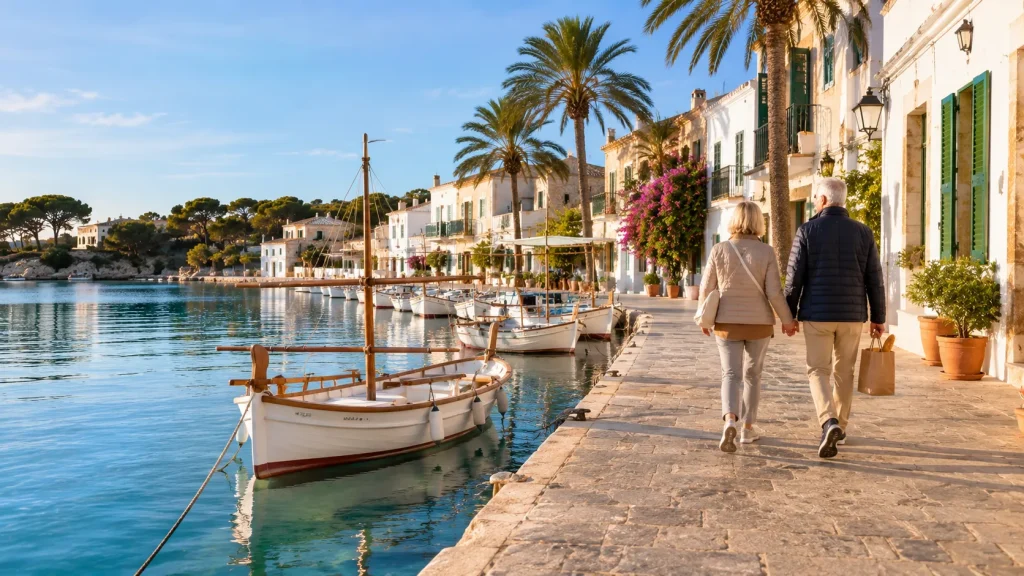
- Everything on foot: bakery, pharmacy, doctor and café. In a lively village such as Portocolom, much can be done without a car; in an isolated finca you will need one for every errand.
- Winter comfort: many Mallorcan homes are built for summer. Ask about heating, insulation, windows and damp; the energy certificate gives a first idea.
- Upkeep: a large garden and a pool cost time or money. An apartment with a communal pool is often easier; see buying an apartment in Mallorca.
- The village in winter: visit in November or February. If you will live here all year, you will want neighbours and open shops out of season too.
Healthcare in the southeast
Portocolom has its own primary care unit, part of the Felanitx health centre. The public reference hospital for Felanitx, Santanyí, Manacor and Campos is Manacor Hospital; in an emergency you will be treated at any hospital. For daily life in the village, read living in Portocolom; for the bigger picture, moving to Mallorca.
Retiring in Portocolom: how we help
We live in Mallorca ourselves and know first-hand the questions newcomers ask. We show you apartments and houses that suit your daily life and guide you through the whole purchase, in English, German or Spanish. Browse our property for sale or get in touch; to compare areas, read where to buy property in southeast Mallorca.
If the village suits you, here is our property for sale in Portocolom.
Frequently asked questions
Will my pension be reduced if I move to Mallorca?
Within the EU, generally not: you keep receiving your full pension from home, and it can be paid into a Spanish account.
Do I pay Spanish tax on my foreign pension?
If you are tax resident in Spain, yes. The tax treaty with your country prevents double taxation; with Germany, for example, Germany may levy a limited tax (5 % or 10 %) that Spain credits.
Can I see a doctor in Mallorca with my home insurance?
Yes, with the S1 form if you live here. If you only spend part of the year here, use your European Health Insurance Card.
Can I spend just the winter in Mallorca?
Yes. You then usually remain tax resident in your home country and pay the non-resident taxes on your Mallorca home.
This article is for general information and is up to date as of November 2026. It does not replace legal or tax advice; rules and procedures may change.